Sunday, November 23, 2008

Actual and/or Potential Disadvantages for Organizations to use The Iris Recognition Biometric System


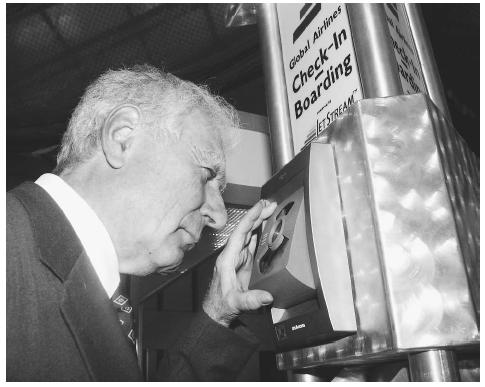
Even though the Iris Recognition Biometric is the most reliable and highly accurate biometric available today it does posses some disadvantages. There are several issues and concerns that affect most organizations when dealing with the implementation of this device. The main disadvantage is gaining the trust of individuals about the system and getting them to try to use the device. The human eye is a very sensitive and precious organ of the body and individuals do not wish use devices that may cause it harm. Furthermore in work places with senior employees, it may be difficult for them to concentrate on an opening of less than one cm and hold and maintain that position for several seconds. If this procedure is not done correctly it may disturb the image scanned(1).

To find out more visit:
http://www.idteck.com/technology/w_iris.jsp

Many industries today want to have least costly but highly accurate security devices. Although the Iris Recognition Biometric is the most accurate biometric that exists in the market today, it also is the most expensive one to implement. Some companies refrain from using this device simply because not enough funds are available to support the system.(2)

One industry that the iris scan may not be of great use is the forensic industry of crime scene investigation. For example, fingerprints can be left behind as evidence, which can be scanned and matched with an individual. Iris patterns or prints are usually very hard to capture during such scenes due to the distance of which images are captured.(3)

References

(1) Raviraj Technologies, http://www.ravirajtech.com/iris-recognition-biometric-authentication-information.html, 10 November, 2008.
(2)The Child Project, http://www.thechildproject.org/iris-recognition-primer.html, 15 November, 2008.
(3)Iris Devices.Net, http://irisdevices.net/iris_advantages/, 14 November, 2008.

Actual and/or Potential Advantages for Organizations to use The Iris Recognition Biometric System


There are several advantages in using iris recognition technology as opposed to any other biometric technology. The main advantage of this system consists of the fact the human eye is always visible and is well protected by eyelids and lashes. The eye also does not undergo drastic changes in texture and pattern and is fairly stable as of the age of one. The eye pattern on each individuals eye is unique and complex, which is hard to duplicate, but can easily be scanned by a camera.

The iris recognition system is rapidly growing in the airline industry.Airports in Germany and North Carolina have already implemented this technology allowing frequent travelers to go through the boarding process faster and with greater ease. Furthermore, this technology is being used at border crossing eliminating the need to obtain proper identification cards and passports of immigrants.(1)

Due to the accuracy of this device, it is slowly making its way into prisons and is being used to identify inmates. This is an act of social responsibility that ensures public safety by eliminating the risk of releasing the wrong inmate. In addition, there are several advantages in using this technology in hospitals. Hospitals in Germany are using such technology to protect areas where newborns are kept by granting access to only authorized individuals.(2) Many hospitals around the United States have used Iris scanning technology to protect highly confidential documents such as patient records. This is a safer and more precise security method being implemented as opposed to traditional use of magnetic cards which can easily be duplicated or stolen. This gives assurance to patients that there information is protected and decreases the risk of such information being transferred to unauthorized individuals.

In the future this technology will be seen in banks and ATM machines. This is extremely advantages because it not only eliminates the problem of lost debit cards or pins but also cases of identity fraud. It further decreases number of unauthorized transaction which eventually increases the profitability of the banking industry. Overall, it would bring assurance to clients that their investments are well secured. (3)

Several companies will be using biometric devices in various products in the future. To learn more visit http://www.cl.cam.ac.uk/~jgd1000/iris_recognition.html


References

(1)The Child Project, http://www.thechildproject.org/iris-recognition-primer.html, 20 November, 2008.

(2)Raviraj Technologies, http://www.ravirajtech.com/iris-recognition-biometric-authentication-information.html, 10 November, 2008.

(3) Center for State Courts, http://ctl.ncsc.dni.us/biomet%20web/BMIris.html, 19 November ,2008.

Technology and Tools The Iris Recognition Biometric System Replaces


There are numerous biometric systems available such as the retina scans, facial recognition, and fingerprint. The main function of all these devices is to provide more accurate and reliable security measures as opposed to traditional security measures.

The biometric device that is quite similar and is in danger of being replaced by the iris scan biometric is the retina scanning biometric. The retina scanning biometric consists scanning of the retina of the eye as opposed to the iris. It consists of getting an individual to concentrate on a light within the camera and avoid blinking or any movements. It takes about ten to fifteen seconds for the retina scan to be complete as opposed iris scans that takes a few seconds. There are many disadvantages to the retina scan biometric such as it is not as accurate as the iris scan because the retina may change due diabetes or other disorders. Furthermore, long exposure to the light used in this system may not be good for the eye and it may be difficult for some individuals to hold still for long periods of time.(1)

For more information on retina scanning visit:


Other biometrics available in the market today such is the fingerprint, facial and voice recognition systems. The main reason why these systems are used a lot today is that they are less expensive and readily available than the iris recognition biometric. However these biometric systems produce less accurate results and are much slower. For example, the finger print biometric is tweleve times slower than the iris recognition system. (2) In addition, the voice recognition system has a misidentify rate of 1/30, facial recognition has a rate of 1/100, and finger print recognition has a rate of 1/1000. Where as the iris recognition system has a misidentify rate of 1/1200000, which is a lot lower than any of these other systems(3).


References

Iris Recognition Biometric System- What it is and Does.


Biometric devices use unique features
of the body such as the fingerprints, facial, voice and Iris recognition in order to identify an individual. The most accurate and reliable biometric that exists today is the Iris Recognition Biometric which uses the unique feature of the body, the human eye. This device is being used across the globe in large industries, prisons, and airports such as in Germany and North Carolina. Due to the reliability and accuracy of such devices in the future they may be more visible in places such as banks and hospitals.

The reason that this device is so successful is the fact that each in
dividual has a unique iris, the
colored part of the eye surrounding the pupil, which is responsible for dilating and contracting the pupil size. Each human eye, as well as both eyes on the same individual, have a unique color, texture and pattern. Furthermore, what makes the human iris fairly dependable is the fact that the iris is fairly stable and does not undergo drastic changes throughout an individual’s life time.

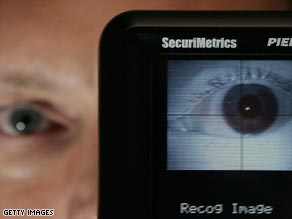
In order to be able to use any biometric device the first step is to register an individual on to it. Registration includes entry of data such as name, id number, etc., as well as an initial iris scan which the system uses to identify and store the unique characteristics and patterns of that particular person’s eye. The system consists of three parts the sensor or camera, the computer which analysis the information and the software which compares the information from the camera to that stored.(1) The Iris recognition system is one of the few biometric devices that do not include any physical contact. How this technology works is that once the camera detects an object, about three to ten inches away is the ideal range to stand, it automatically adjusts and focuses into the eye. The camera then screens the eye using infrared light and matches the image scanned to the one stored onto its database. (2)

For more information on how the Iris Recogntion biometric works visit:

ftp://ftp.panasonic.com/pub/Panasonic/cctv/White%20Papers/Iris52005.pdf

Iris recognition technology is the fastest and least error prone method of biometric identification. It takes about one second for the camera to analyze the image and can have search images of up to 1,500,000 per minute.(3) Furthermore, the Iris recognition system is not only the fastest but the most efficient biometric device in the market today having a 1*10^48% false positive rate. It also produces a much lower false rejection rate, which averages
1 in 1.2million scans, which is extremely low when compared to the rest of the biometric systems.(3)


References

(1)How stuff Works- A Discovery Company, http://science.howstuffworks.com/biometrics.htm. 19 November ,2008.

(2)The Child Project, http://www.thechildproject.org/iris-recognition-primer.html, 15 November, 2008.


(3)Iris Scan technology, http://74.125.95.132/search?q=cache:nKPYAfyrkYUJ:seminarinfo.blogspot.com/2006/07/iris-scan-technology.html+Iris+Recognition+time+to+do+scan&hl=en&ct=clnk&cd=4&gl=ca&client=firefox-a, 18 November, 2008.